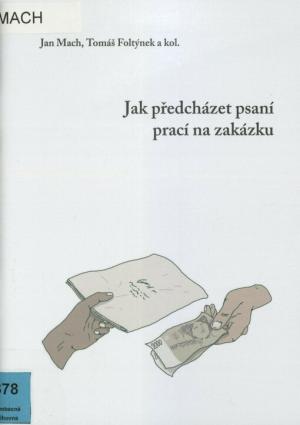
Jak předcházet psaní prací na zakázku
Keywords:
qualification works, authorship, impostures, contract cheatingSynopsis
This document addresses the fraud known as contract cheating, academic ghostwriting, or essay milling. Contract cheating is an offense where an individual utilizes an unacknowledged or unauthorized third party to help them draft a piece of work in order to gain credit, grades, academic advancement, or similar advantages. Contract cheating is known to the general public mainly in connection with the offers of commercial companies that advertise essay writing services on the internet. The common features of their websites and their principle of operation are presented in a separate chapter. Subsequently, the issue of contract cheating, major scandals, legislation, and research abroad and in the Czech Republic are described. To explain the causes of contract cheating, the authors utilized the so-called fraud triangle, a model mapping an individual's reasons for this fraudulent behavior from the perspectives of motivation, pressure, opportunity, and rationalization. The main factors contributing to a student's decision to commit fraud and have a paper written include a lack of interest in completing the assignment, a lack of confidence in one's own abilities, an actual inability to write the paper, or external factors. A critical topic when dealing with contract cheating involves the additional risks associated with it, such as low quality of the submitted work, failure to deliver the work, the danger of the fraud being detected, blackmail, or the lack of knowledge in a graduate. The findings obtained based on risk research serve as the second main pillar for formulating recommendations. Another frequently mentioned specificity of contract cheating is its difficult detectability. The options for identifying work written to order are limited. In this guide, we attempt to summarize existing practical tips for when contract cheating is suspected. It is crucial to focus primarily on prevention. Within the recommendations for students, we present practical tips that share a common denominator: do not be afraid of completing the work on your own, as it will always be better than a falsified piece of work by someone else. Recommendations for educators focus mainly on how to set conditions that emphasize authentic assessment and make it harder for students to outsource their assignments. Institutions and policymakers are the ones who set the normative conditions within which teachers and students operate. The more explicit they are in their rejection of contract cheating, the less room for fraud potential perpetrators will have. As a first step, for instance, institutions should include a ban on practices like contract cheating (and similar ones) in their internal regulations. In terms of prevention, universities should focus on reducing pressure on students, reducing opportunities for fraud, and reducing the rationalization of fraud by students. Public awareness, education of students and staff, and preventing any forms of promotion of contract cheating services on school grounds are important. Selected technical solutions are also mentioned. As demonstrated by the example of countries that already have experience with this, legislation can be a significant help in eliminating contract cheating and its associated risks. The aim is not merely to help the academic sector resolve its internal matter (cheating in exams). If contract cheating were to remain without more thorough control in the Czech Republic, it could become a major threat to the integrity and reputation of the higher education sector. A legislative ban on providing and advertising academic text writing services to order appears to be a suitable solution to the problem. Within the recommendations at the national level at the end of the document, a recommendation for the legislation of the Czech Republic is formulated based on good practice abroad.
Downloads
References
Clarke, R., Lancaster, T. (2006). Eliminating the Successor to Plagiarism? Identifying the Usage of Contract Cheating Sites. Proceedings of the 2nd International Plagiarism Conference, Gateshead, UK. Dostupné na: [suspicious link removed].
Cressey, D. R. (1953). Other People’s Money; A Study of the Social Psychology of Embezzlement. New York, NY, US: Free Press.
Curtis, G. (2021). Contract Cheating. UWA School of Psychological Science. Dostupné na: https://www.auckland.ac.nz/en/staff/learning-and-teaching/academic-integrity/contract-cheating.html.
Curtis, G. J., Vardanega, L. (2016). Is Plagiarism Changing Over Time? A 10-Year Time-Lag Study with Three Points of Measurement. Higher Education Research & Development, 35 (6), 1167–1179. DOI: 10.1080/07294360.2016.1161602.
Dawson, P., Sutherland-Smith, W. (2019). Can Training Improve Marker Accuracy at Detecting Contract Cheating? A Multi-Disciplinary Pre-Post Study. Assessment & Evaluation in Higher Education, 44 (5), 715–725. DOI: 10.1080/02602938.2018.1531109.
Eaton, S. E. (2021). Plagiarism in Higher Education: Tackling Tough Topics in Academic Integrity. ABC-CLIO. ISBN 978-1-4408-7437-6.
Ellis, C., van Haeringen, K., Harper, R., Bretag, T., Zucker, I., McBride, S., Rozenberg, P., Newton, P., Saddiqui, S. (2019). Does Authentic Assessment Assure Academic Integrity? Evidence from Contract Cheating Data. Higher Education Research & Development, 39 (3), 454–469. DOI: 10.1080/07294360.2019.1680956.
ENAI (2018). Contract Cheating. Dostupné na: https://www.academicintegrity.eu/wp/glossary/contract-cheating/.
Florida Statutes (2011). Chapter 877.17. Dostupné na: https://www.flsenate.gov/Laws/Statutes/2011/877.17.
Foltýnek, T., Henek Dlabolová, D. (2021). Manuál učitele PEF: Řešení prohřešků studentů. Mendelova univerzita v Brně, interní dokument.
Foltýnek, T., Králíková, V. (2018). Analysis of the Contract Cheating Market in Czechia. International Journal for Educational Integrity, 14 (1), 4. DOI: 10.1007/s40979-018-0027-8.
HESP (2018). HESP Advice on Student Academic Integrity and Cheating. Dostupné na: https://www.dese.gov.au/higher-education-standards-panel-hesp/resources/hesp-advice-student-academic-integrity-and-cheating.
ICAI (2021). The Fundamental Values of Academic Integrity. Dostupné na: https://academicintegrity.org/resources/fundamental-values.
Kampaň #zvladnutolepe (2020). Akademická etika. Dostupné na: https://www.akademickaetika.cz/zvladnutolepe/.
Kennedy, K. (2018). BBC Uncovers More than 250 YouTubers Promoting Academic Cheating. The Pie News. Dostupné na: https://thepienews.com/news/bbc-uncovers-more-than-250-youtubers-promoting-academic-cheating-to-students/.
Králíková, V. (2017). Analýza trhu s podvodnými seminárními a závěrečnými pracemi v ČR. Mendelova univerzita v Brně, diplomová práce. Dostupné na: https://is.mendelu.cz/lide/clovek.pl?id=50123;zalozka=7;zp=58193.
Králíková, V., Foltýnek, T., Dannhoferová, J., Dlabolová, D., Turčínek, P. (2018). Global Essay Mills Survey in Czechia: Insights into the Cheater’s Mind. In Razı, S., Glendinning, I., Foltýnek, T. (ed.) Towards Consistency and Transparency in Academic Integrity. Bern, Switzerland: Peter Lang.
Králíková, V., Vajdíková, R., Foltýnek, T. (2019). Global Essay Mills Survey: Is Student Cheating Related to the National Economy? Ethical Perspectives, 26 (1), 91–118. DOI: 10.2143/EP.26.1.3286290.
Lancaster, T. (2019). Contract Cheating. Dostupné na: http://thomaslancaster.co.uk/contract-cheating.
McNeilage, A., Visentin, L. (2014). Yingying Dou: The Mastermind Behind the University Essay Writing Machine. The Sunday Morning Herald, 2014/11/12. Dostupné na: https://www.smh.com.au/education/yingying-dou-the-mastermind-behind-the-university-essay-writing-machine-20141111-11kk50.html.
Newton, P. M. (2018). How Common Is Commercial Contract Cheating in Higher Education and Is It Increasing? A Systematic Review. Frontiers in Education, 3, 67. DOI: 10.3389/feduc.2018.00067.
O’Malley, M., Roberts, T. S. (2012). Plagiarism on the Rise? Combating Contract Cheating in Science Courses. International Journal of Innovation in Science and Mathematics Education, 20 (4), 16–24.
Orosz, G., Tóth-Király, I., Bőthe, B., Kusztor, A., Üllei Kovács, Z., Jánvári, M. (2015). Teacher Enthusiasm: A Potential Cure of Academic Cheating. Frontiers in Psychology, 6 (MAR), 1–12. DOI: 10.3389/fpsyg.2015.00318.
Owens, C., White, F. A. (2013). A 5-Year Systematic Strategy to Reduce Plagiarism among First-Year Psychology University Students. Australian Journal of Psychology, 65 (1), 14–21. DOI: 10.1111/ajpy.12005.
Parliament of Australia (2019). Tertiary Education Quality and Standards Agency Amendment (Prohibiting Academic Cheating Services) Bill 2019. Dostupné na: https://www.aph.gov.au/Parliamentary_Business/Bills_Legislation/Bills_Search_Results/Result?bId=r6483.
Přispěvatelé Wikipedie (2019). Essay mill. Wikipedie: Otevřená encyklopedie. Dostupné na: https://en.wikipedia.org/wiki/Essay_mill.
QAA (2019). Qualifications and Quality Assurance (Education and Training) (Amendment) Act 2019, Number 32. Dostupné na: https://data.oireachtas.ie/ie/oireachtas/act/2019/32/eng/enacted/a3219.pdf.
QAA (2020). Contracting to Cheat in Higher Education: How to Address Essay Mills and Contract Cheating. 2. vyd. Dostupné na: https://www.qaa.ac.uk/docs/qaa/guidance/contracting-to-cheat-in-higher-education-2nd-edition.pdf.
QQI (2021). Academic Integrity. Dostupné na: https://www.qqi.ie/Articles/Pages/Academic-Integrity.aspx.
Sněmovní tisk 887/0 (2020). Návrh poslanců Jakuba Michálka, Ivana Bartoše, Františka Navrkala, Mikuláše Ferjenčíka a dalších na vydání zákona, kterým se mění zákon č. 111/1998 Sb., o vysokých školách a o změně a doplnění dalších zákonů (zákon o vysokých školách), ve znění pozdějších předpisů, a zákon č. 40/1995 Sb., o regulaci reklamy a o změně a doplnění zákona č. 468/1991 Sb., o provozování rozhlasového a televizního vysílání, ve znění pozdějších předpisů. Dostupné na: https://www.psp.cz/sqw/text/orig2.sqw?idd=177906.
Sutherland-Smith, W., Dullaghan, K. (2019). You Don’t Always Get What You Pay for: User Experiences of Engaging with Contract Cheating Sites. Assessment and Evaluation in Higher Education, 44 (8), 1–15. DOI: 10.1080/02602938.2019.1576028.
Tennant, P., Duggan, F. (2008). Academic Misconduct Benchmarking Research Project: Part II. Dostupné na: http://marketing-porg-statamic-assets-us-west-2.s3.amazonaws.com/main/Tennant_amber2.pdf.
Visentin, L. (2015). MyMaster Essay Cheating Scandal: More than 70 University Students Face Suspension. The Sunday Morning Herald, 2015/03/18. Dostupné na: https://www.smh.com.au/national/nsw/mymaster-essay-cheating-scandal-more-than-70-university-students-face-suspension-20150312-1425oe.html.
Wallace, M. J., Newton, P. M. (2014). Turnaround Time and Market Capacity in Contract Cheating. Educational Studies, 40 (2), 233–236.